
Basics
Palettization compresses model weights by clustering them into a look-up table (LUT) of centroids. Each weight value is replaced by an index into the LUT, reducing storage from full-precision floats to a small number of bits per weight.
Weights with similar values are grouped together and represented using the value of the cluster centroid they belong to. The original weight matrix is converted to an index table in which each element points to the corresponding cluster center.
n_bits={1,2,3,4,6,8} are supported, where n_bits is the number of bits used for palettization. In other words, each weight value will be represented using n_bits precision, and the size of the LUT will be 2^n_bits (see figures below for a visual explanation).
Scalar and Vector Palettization
There are two types of palettization supported by coreai-opt:
Scalar palettization (default): each weight value is treated independently and the clustering process essentially involves performing K-means on one-dimensional data.
Vector palettization: weight values can be treated as vectors of dimensionality
cluster_dim. For example, withn_bits=4andcluster_dim=2, K-means will happen on 2-D data with2^4=16cluster centers. Hence, the resulting LUT will have a size of16x2. Since each tuple of weight values will be represented by 4 bits, the effectivebpw(bits per weight) would be4/2 = 2 bpw. This would give a similar compression ratio to scalar palettization withn_bits=2(ignoring the space occupied by the LUTs themselves, which are typically much smaller compared to the weight tensors).
Granularity
For both scalar and vector palettization, there are two modes (aka granularities) available:
per_tensor: a single LUT is computed for the whole tensor.
per_grouped_channel: multiple LUTs per weight tensor. The weight tensor is divided into groups, each with its own LUT. The number of LUTs is controlled by the
group_sizeparameter. For example, a weight of shape(1024, 2048), withgroup_size=16, applied onaxis=0, will have1024/16 = 64LUTs, each covering a slice of weight values of shape(16, 2048). This helps in reducing the error, and increasing accuracy of the palettized model.
Visual Examples
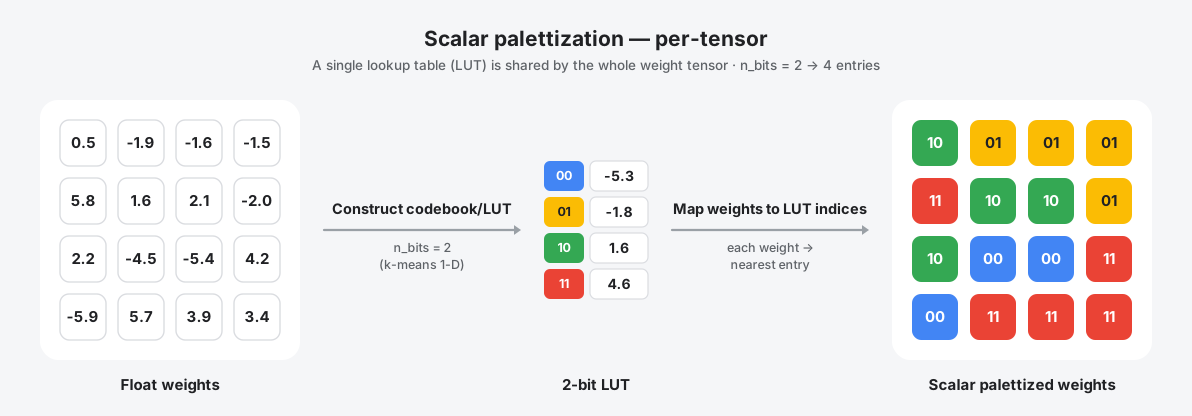
Scalar palettization with per-tensor granularity: a single LUT is shared across the whole weight tensor.
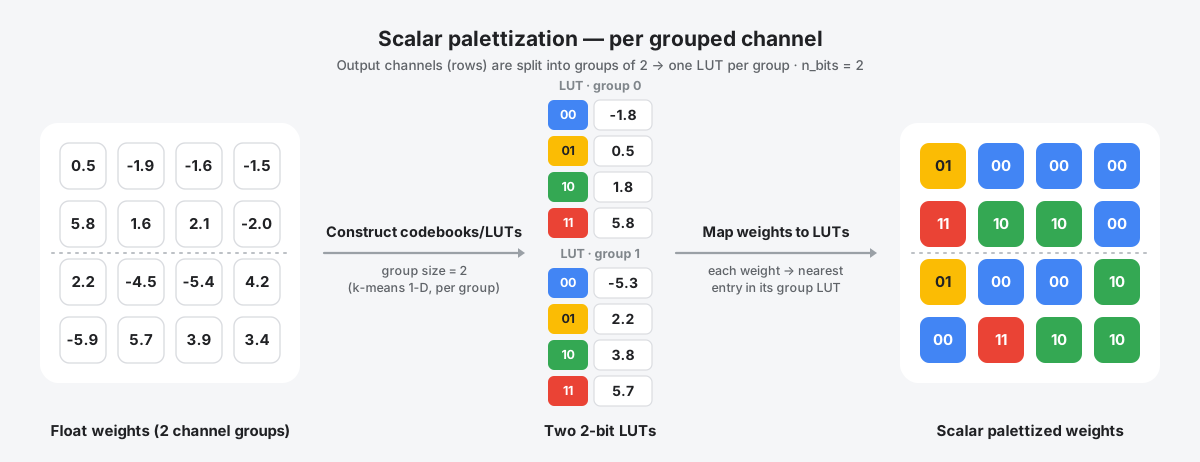
Scalar palettization with per-grouped-channel granularity: the weight tensor is split into groups, each with its own LUT.
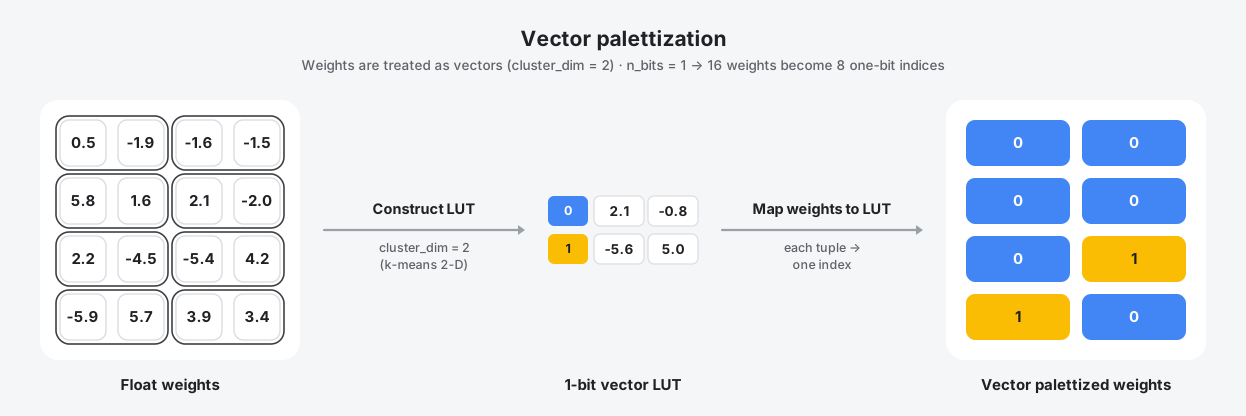
Vector palettization: tuples of weight values are clustered together, so each LUT entry is a vector of dimension cluster_dim.